
Losing a tooth, or multiple teeth, is not as uncommon as many people think, and the choices of replacement have never been better. Dental bridges and dental implants are two of the most recommended missing tooth solutions. They both leave your smile and your comfort of chewing intact, but they do so in very different ways, and in different situations. Should you be having a dilemma as to which one is better than the other, then this guide takes you through all the things that you need to know in such simple and clear terms that you will be having a genuinely informed conversation with your dentist.
1. What is the difference between Dental Bridges and Dental Implants?
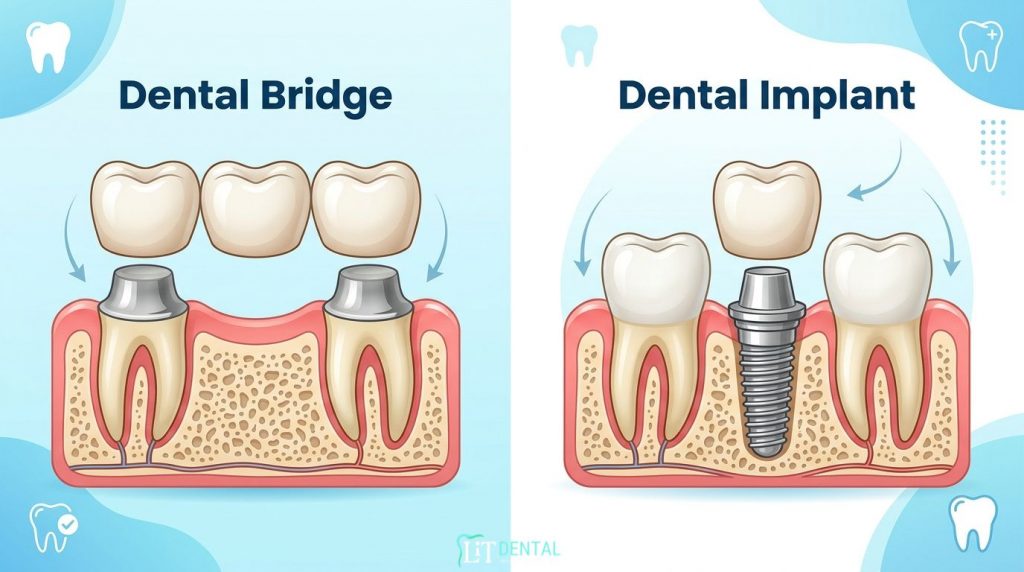
Both are good tooth replacement procedures – but even structurally and functionally, they are very different. A dental bridge is used to fill in the gap caused by a lost tooth by attaching a false tooth to the two natural teeth on either side of the gap. A dental implantation is the replacement of the missing tooth root with a titanium post surgically fitted into the jawbone, and topped with a crown. To understand the advantages and disadvantages of bridge vs implant, it is important to comprehend this basic structural difference between the two methods.
Form and How Each of the Options performs.
- Dental bridge is a fixed restoration that is wholly supported by the other adjacent natural teeth which must be prepared and crowned to support the bridge firmly in place over the gap.
- A dental implant is a self-contained type of tooth replacement, as the titanium post bonds itself to the jawbone, and, in effect, they are self-sustaining.
2. Which one has a longer lifespan: Dental Bridges or Implants?
In the case of comparison of missing tooth solutions in terms of long-term value, it is evident that the implants have a long-term superiority regarding their value. Which lasts longer, dental implants or bridges? Yes, to the majority of patients. Dental implantation is designed to last a lifetime with the appropriate care- with the crown part going as long as 15 to 25 years with proper care. Dental bridges typically have a lifespan of 10 to 15 years before wear, decay risk at the margins or structural changes necessitate replacement or renewal.
Long-term performance and durability.
- By simulating the natural tooth root, dental implants maintain the jawbone density by preventing bone loss occurring in the jaw after tooth loss and contributing to their remarkable long-term structural stability.
- Dental bridges fail to deal with underlying bone loss and have continued stress on anchor teeth over time – factors that can be used to determine the long span of both the bridge and the supporting natural teeth.
3. Which is better: Dental Implantations or Bridges in Replacing Missing Teeth?
The advantages and disadvantages of Bridge vs implant are highly dependent on the specific case of the individual patient oral health, bone density, budget, and treatment schedule all have a role to play. Can dental implants surpass the use of bridges in all circumstances? Not in every case. Implants are the best long-term method of replacing teeth of most healthy patients, but bridges are also a clinically reasonable and effective approach in most circumstances where implants are not immediately applicable.
Advantages and disadvantages of Both.
- Implants maintain jawbone, have no effect on adjacent teeth, and they have the longest lifespan of any missing tooth solution – making them the most preferred solution to most patients with adequate bone density and lacking any contraindication to surgery.
- Bridges are placed quicker, less expensive initially and do not require any surgery at all; making them a viable tooth replacement option in patients who need a quicker solution or are not prequalified to undergo implant surgery at the time of treatment.
- Bridge vs implant advantages and disadvantages can be summarized as the fact that bridges involve modification of healthy adjacent teeth a permanent and irreversible process that implants completely avoid by functioning as independent restorations.
- Between dental implants and bridges, which is superior in patients with several missing teeth in various locations? Generally yes – since each implant is an independent entity, but a multi-tooth bridge imposes a more complex structural dependency on the surrounding natural teeth.
4. What is the Dental Bridge vs. Dental Implant in terms of comfort and appearance?
Both types of missing tooth solutions are meant to be as natural as possible in both appearance and feel and modern dental technology has made both solutions remarkably lifelike in appearance and feel. The wearing process of each of them is therefore different in a way that is significant to the patients in their normal living experiences.
- Dental implants are the closest ones to the natural teeth since it is fixed directly in the jawbone – there is no movement, no stress on the surrounding teeth, and there is no feeling of wearing a dental appliance.
- Dental bridges are fixed and non-removable, hence comfortable compared to dentures, although some patients may find this difference in sensation around the anchor teeth a slight difference.
On an appearance front, both bridges and implants can be perfectly matched to the color and shape of your natural teeth surrounding the bridge and or implants – making either tooth replacement choice virtually the same in a natural smile. The decision on bridge vs implant advantages and disadvantages in a comfort and aesthetics viewpoint is ultimately placed in the hands of personal experience and clinical suitability measured by your licensed dental professional.

Conclusion
The decision to choose between a bridge or an implant is an exercise that requires a professional advice depending on your oral health condition. Both are known to be missing teeth solutions and the correct choice towards you should be based on factors that can only be properly examined by a qualified dental examination.
LiT Dental provides full restorative dental services such as dental implants, dental bridgework, dental crowns, dental veneers, and dental bonding – with an experienced staff who will help you clearly understand everything. Make an appointment with LiT Dental and start the process of having a full and confident smile.
