
The dental condition of buck teeth presents common recognition yet suffers from severe public misunderstanding. Many people wonder whether they are purely a cosmetic issue or whether they can actually affect oral health. The answer is both. You need to understand the causes of buck teeth their untreated consequences and your available treatment options before you can choose your dental treatment. We will present information to you through an organized and clear presentation.
What Are Buck Teeth and How Are They Identified?
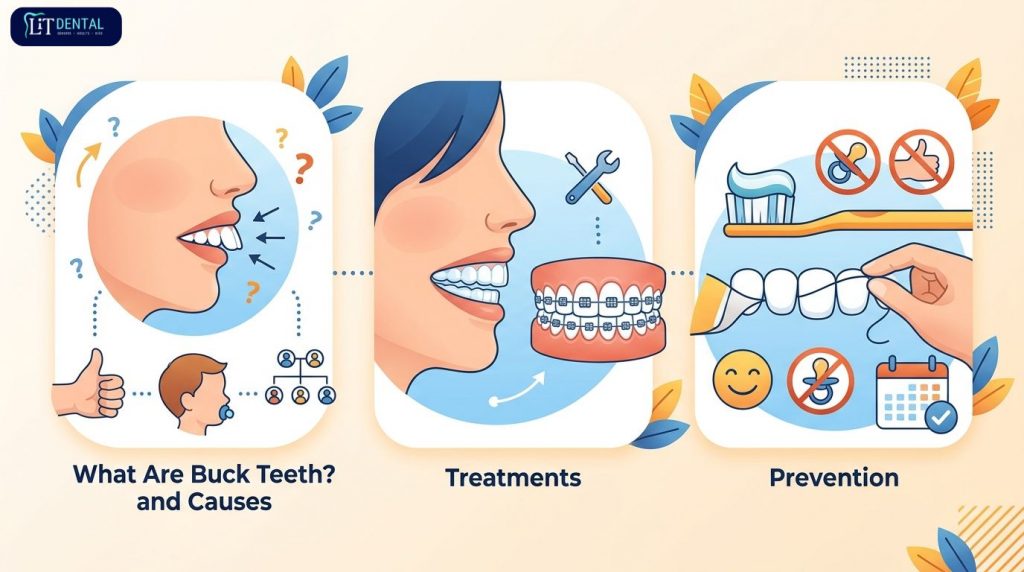
Buck teeth refer to upper front teeth that stick out further than they should beyond the lower teeth. The dental condition (overjet) causes teeth to extend outside their normal biting position, according to dental scientists. Although both conditions involve upper teeth overlapping lower teeth, the two conditions differ because standard overbites show different patterns of tooth movement.
The severity of the protrusion determines whether buck teeth create health problems. The mild cases show mostly aesthetic effects, but more severe protrusion impacts how people bite and speak and it also affects their future jaw development. A dentist can identify buck teeth during a routine dental examination.
Understanding Overbite and Tooth Protrusion
- An overbite refers to how much the upper teeth vertically overlap the lower teeth. Buck teeth, or overjet, specifically describes how far the upper teeth protrude horizontally — pushing forward rather than just downward over the lower teeth.
- Identification is straightforward. A person demonstrates protrusion if their upper front teeth extend forward from their face when their mouth stays in a relaxed position. A dental professional can measure the exact degree and determine whether treatment is recommended.
What Causes Buck Teeth to Develop in Children and Adults?
The causes of buck teeth are not always the same for every person. Some people are born with a jaw structure that naturally leads to protrusion. Others develop it over time due to habits or changes in the mouth. The different treatment results from understanding buck teeth causes which help explain their distinct clinical outcomes in each patient. Are buck teeth permanent without treatment? Most cases prove that dental professionals must intervene because self-correction does not occur. The identification needs to happen at an early stage because all available treatment options will become accessible.
Genetics, Habits, and Jaw Alignment Factors
- Genetic factors along with personal behaviors and jaw alignment pattern determine how people develop buck teeth. Genetic factors represent the primary reason people develop buck teeth. Protruding teeth or a small jaw present in a parent or grandparent will probably be passed down to their descendants. People inherit jaw size and tooth size which determine how their teeth will align within their mouth.
- Jaw misalignment occurs when the upper and lower jaws do not grow at the same rate or in the same direction. The upper jaw grows forward from the lower jaw which causes the front teeth to protrude in a visible manner.
- Prolonged oral habits in childhood, such as extended pacifier use or thumb sucking, are well-documented causes of buck teeth. The continuous pressure applied to front teeth during multiple months or years leads to their gradual movement into a position of permanent protrusion.
Can Thumb Sucking or Pacifier Use Lead to Buck Teeth?
Yes, this practice demonstrates a high frequency of occurrence among parents. Thumb sucking and pacifier use are completely normal in early infancy. The concern begins when these habits continue past the age of three or four, when the permanent teeth are beginning to develop. Children develop buck teeth through this particular combination of behaviors. Do buck teeth remain permanent after they form through these behaviors? The answer remains yes because people need dental treatment to avoid permanent results hence the importance of regular monitoring.
Childhood Habits and Dental Development
- Thumb sucking creates consistent forward pressure on the upper front teeth. The dental pressure which starts during early development and continues through the formative years of tooth growth will result in teeth displacement which leads to jaw arch deformity over time.
- Pacifier use beyond age three carries a similar risk. The risk remains low when people use pacifiers occasionally but their extensive use during permanent teeth development will lead to dental protrusion which needs future correction.
What Problems Can Buck Teeth Cause If Left Untreated?
Are buck teeth harmful when left alone? The effects of these conditions extend beyond their visual impact because they present actual health risks to patients. The various factors that lead to buck teeth creation result in similar outcomes when people decide to disregard their present condition. Are buck teeth permanent without care? The answer to this question stands at yes because this situation becomes increasingly hard to manage with time. Early professional evaluation gives you the clearest picture of what is happening and what can be done.
Effects on Oral Health and Appearance
People experience direct difficulties with their ability to bite and chew food. Upper teeth which extend beyond normal boundaries create a problem because they prevent upper and lower teeth from making proper contact.

Conclusion
The best treatment for buck teeth depends on age, severity, and the underlying cause. Early orthodontic intervention in younger children helps guide their jaw development. Teens and adults have several treatment options which include orthodontic appliances and restorative services such as dental bonding and veneers and crowns which restore the appearance and function of teeth affected by buck teeth.
The team at LiT Dental provides assistance for anyone who wants to learn about buck teeth treatment options for themselves or their child. LiT Dental supports your smile at every stage through its patient-first approach which includes complete dental services.
