
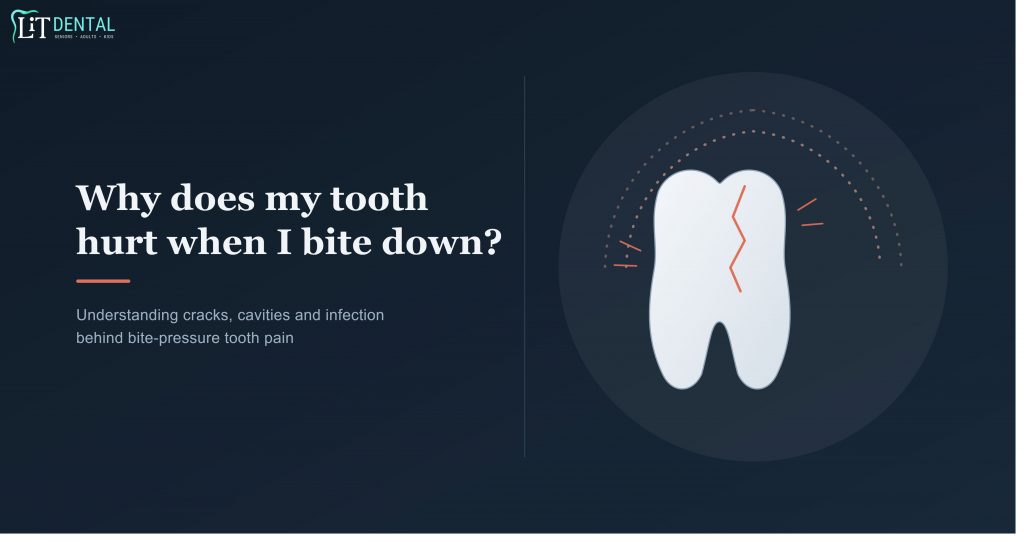

When your tooth hurts when you bite down, it’s nearly always a reflection of something that’s wrong with that tooth, and that’s an indicator that you should have it checked out by a professional. The pain could be acute and sudden or it could be a dull ache that only becomes apparent when straining. In either case, your tooth is sending you a very clear message. This blog talks about the most frequently occurring causes, the symptoms and how a dentist can determine the exact cause.
What is the most frequent cause of a toothache when biting down?
For most of the patients who present with tooth pain when biting, the cause of pain is a crack, cavity, damaged restoration, infection or inflammation around the root or surrounding gum tissues. The nature of the pain (e.g., sudden or gradual, sharp or dull) and its location are clues that help establish a diagnosis before any examination.
Pressure-Related Tooth Pain
Tooth pain from pressure is caused by irritation or damage of the internal structures of the tooth, the dentin, the pulp or the surrounding ligament. These structures are compressed by the biting and cause pain. Can a cavity cause pain when biting? Yes — deep cavities expose the inner dentin and pulp, which will cause discomfort when biting on the tooth and will be obvious.
Does a Cracked Tooth or Damaged Filling Give Pain When Eating?
Yes: A damaged filling or cracked tooth is among the most common reasons for tooth sensitivity when biting. Cracks are not always visible, and a damaged filling can feel OK when not in use, but cause sharp pain the first time pressure is put on it.
Symptoms of Structural Damage and What they Mean
- Cracked tooth syndrome causes sharp, localized pain with biting which comes and goes rapidly; often, the exact tooth can be difficult to locate without professional testing and clinical evaluation.
- If a tooth filling is high, or damaged, your bite will compensate during each meal all day, leading to soreness in the muscles of your teeth and jaw.
- Grinding wears away the outer enamel, causing increased tooth sensitivity as the grinding occurs as well as sensitivity when biting to pressure pain which the outer enamel may withstand without discomfort.
- A loose or failing crown allows movement of the crown and the entrance of bacteria, which results in intermittent tooth pain when biting, depending on the direction and force of the chewing pressure applied to the tooth.
Does it mean a tooth infection or dental abscess if you suffer from tooth pain when biting?
Yes, and this is one of the more serious, which shouldn’t be ignored. If bacteria enter the pulp through a deep cavity, crack or failed restoration, an infection occurs and spreads to the surrounding tissue, creating a great deal of decay sensitivity and constant pain.
Signs of Pulp Damage and Gum Infections
- If the pain persists after biting pressure, and is only alleviated immediately afterwards, this is a good sign that there is pulp involvement or early development of an abscess which should be treated immediately by a dentist.
- A tooth that is causing pain with a visible swelling or bump on the gum indicates a tooth abscess and infection has spread beyond the tooth into the surrounding bone or soft tissue and requires immediate attention.
- Little pain at rest and sensitivity to biting pressure is a sign that the nerve is inflamed or infected, and should not be ignored — contact a dentist immediately for treatment.
- Do cavities make eating difficult? Yes, but once it’s open long enough, it will reach the pulp and result in infection-related pressure pain that worsens with every bite.
What is the diagnosis for a dentist if a patient complains of pain on biting?
When a tooth hurts on biting, there’s more to diagnosis than a visual examination, as the cracks, deep decay and pulp damage often cannot be seen without the proper clinical tools and examination combined.
Dental exams, x-rays and bite tests.
- A special stick is used to bite test and determine exactly which tooth and cusp is responsible for any tooth sensitivity, which will locate the exact location of a crack or damage before any treatment plan is drawn up or discussed.
- Deep cavities, bone loss, dental abscesses and failed restorations are completely hidden in plain sight and are only recognized during a routine dental examination by taking a dental X-ray.
- Pulp vitality testing determines if the nerve is healthy or damaged, so that the most appropriate next step for your situation can be taken; whether that is a filling, a crown or a root canal.

Conclusion
LiT Dental offers full bite pain assessments, which include clinical examination, a detailed digital X-ray and bite testing, to determine exactly what is causing the pain. Not getting the diagnosis early can result in more complex treatment don’t wait for the pain to make things more difficult. At LiT Dental, we are here to help you feel comfortable once more, thanks to our expert and personalized dental care.
