
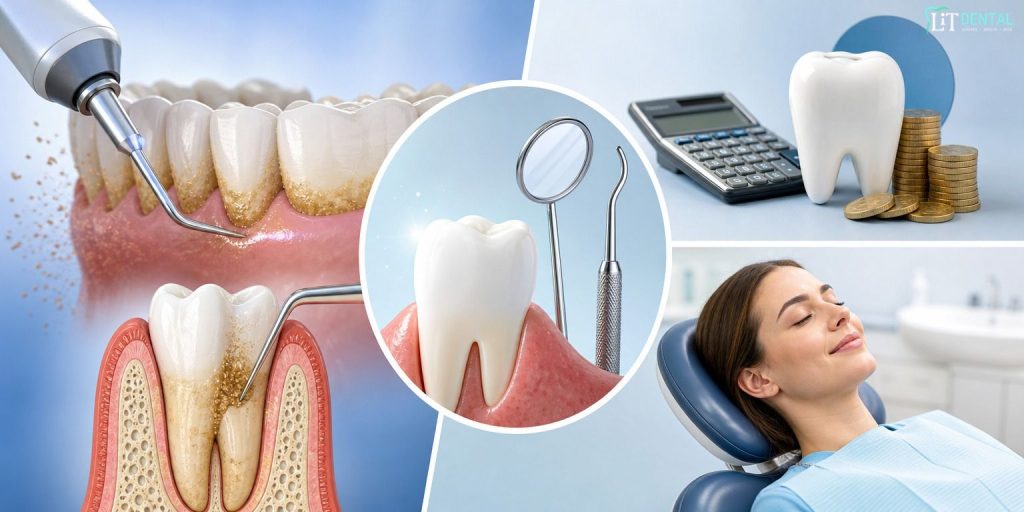
Scaling and root planing is a special cleaning of the teeth that goes under the gum line to allow unhealthy gums to heal. Imagine that your gums are like a tight ring around every tooth. Once germs get under this collar, they may lead to issues you don’t notice right away. This is why sometimes dentists advise you to go further than the normal cleaning. Gum disease is extremely prevalent and is experienced by almost half of the adult population in the United States of America, which is around 30 years old and older. Your gums are important for more than just a beautiful smile they support your teeth. Have you ever asked yourself the question, “What is deep cleaning teeth?” In this blog, we’ll discuss what deep cleaning is, its possible cost, how it feels, how long does deep cleaning take, what to eat after it and what side effects are normal.
What is deep teeth cleaning and why is scaling and root planing suggested?
Deep teeth cleaning is a technique that is responsible for the elimination of plaque and tartar above as well as below the gum line, in addition to smoothing the roots of the teeth. “What is a teeth scaling?” Scaling is responsible for removing the deposits. Root planing allows for getting smooth the surface of roots which makes it possible to promote reattachment of the gums. The dentist usually recommends this procedure when the normal tooth cleaning can’t reach the gum pockets, which are excessively deep.
How Plaque as well as Tartar Accumulation Contributes to Gum Disease
- Every day plaque begins to emerge: the layer of germs covering the teeth after eating.
- Plaque turns into tartar: Tartar emerges when plaque is present for an extended time and cannot be eliminated by brushing.
- Response of gums: Gums become red, swollen and may bleed as a response to germs.
- Pockets develop: Gums separate, wider than 3 mm.
- Damage to bone that supports teeth – over time, infection can damage bone.
- Oral hygiene issues: Long-term smell due to trapped germs.
What is the cost of scale and root planing and what factors impact the final cost?
Scaling and root planing (S & RP) may cost $150 to $350 for each quadrant of the mouth in the U.S. Hence, the mouth in the American system is divided into four sections called quadrants. The cost incurred will depend on the service of the teeth higher than the average fee incurred and whether additional treatments such as X-ray and/or medication are needed.
Insurance coverage policies.
Usually, dental insurance coverage will cover 50% to 80% of the costs of scaling and root planing. Also, there might still be some co-payment or deductible fees, which vary depending on the kind of plan used. There are plans which limit the number of quadrants to be treated each time or each year which should be taken into consideration. It is advisable that upon obtaining the service a written bill should be received from the doctor performing the service.
Does deep teeth cleaning hurt, and what can patients expect during the procedure?
Deep teeth cleaning is performed first to numb the area in order to minimize any pain during the procedure, which can leave many patients feeling little pain. There can be a pressure, scraping or soft vibration as the dentist or hygienist cleans underneath the gum line. Treatment is divided into two visits, patients have one or two sections of their mouth cleaned at each visit.
The Function Of Local Anesthesia And Strategies Used For Alleviating Pain
Local anesthetic is applied on the gums to make them feel numb, similar to the process used in fillings. Before injecting the drug in the gums, a numbing gel is applied to prepare the area. During the process, the patient will also need to know that ultrasonic and hand instruments are used for deep cleaning and the procedure may take about 1-2 hours. Also, a patient will have to be under the influence of anesthesia while having teeth cleaned and, if needed, he or she can raise a hand asking for a break during the procedure.
What is the healing time of gums after scaling and root planing?
The majority of people experience discomfort for 1-3 days after scaling and root planing. A lot of people will go back to work or school the same day or the next day. Gums tend to become less red and swollen in the first week. Gums gradually firm up and begin to heal over the next 2-4 weeks. When gums start to bleed less while brushing, it’s a positive sign they are healing. It may take 4-6 weeks to heal fully below the gum line. This is why your dentist will usually ask you to return for a follow-up appointment about this time to take another measurement of your gums to examine the healing process. If pockets are still deep, more care may be indicated. Many patients will require special maintenance cleanings every 3-4 months rather than every 6 months after healing. These visits will prevent the reoccurrence of germs. At home, two brushings and gentle flossing may help heal, and no smoking.
Which foods are suitable for consumption after a thorough mouth cleaning and which ones should not be consumed?
Make sure to stay away from inadvertently biting your tongue or cheek – test for numbness before eating any food items. You should opt for soft, lukewarm foods that do not need much effort for the first day or two. It is better not to eat solid, crunchy, spicy, sticky or too hot food until your gums are healed completely.
Select food items that can reduce gum irritation during recovery:
Yogurt, smoothies, mashed potatoes, boiled eggs, porridge, and cold soups are great options.
- Soft proteins and fruits: soft fish, tofu, bananas, applesauce.
- Avoid the food pieces that are too small: popcorn, nuts, seeds can get stuck in the areas where gums are healing.
- Avoid the food items with sharp edges: chips, crackers and crusts can hurt gums.
- Try to stay away from acidic food products: citrus fruits, tomatoes, vinegar might cause burning sensation.
- Don’t take alcohol and tobacco products: they slow down the healing process.
- Use water to rinse out the food particles.
- Tooth smart: if possible, chew the food on the side of the mouth that has not been treated.
- Chew smart: If possible, chew the untreated side of the food.
- Rinse with warm salt water (as advised by your dentist).
Making healthy food choices can help simplify the deep cleaning recovery process for deep cleaning.
What side effects might occur following scaling and root planing?
Common side effects are tooth sensitivity, tender/sore gums, light bleeding, and slight swelling. Although some individuals may see their teeth becoming slightly longer when their gums swell and recede. The vast majority of these effects are short-lived, lasting only days or weeks. Contact your dentist if there is increased swelling, heavy bleeding or infection.
Temporary Sensitivity, Tenderness, and Minor Bleeding May Develop
These effects occur for good reason. As tartar is cleared away, sections of the tooth root that were previously hidden may now be exposed to air, food and drinks. Roots are not as hard as the top of the tooth and can be sensitive to cold or hot. Toothpaste designed to treat sensitive teeth can help, but it might take a few weeks. For those with sensitivity, a fluoride treatment might be recommended. Tenderness is caused by the cleaning instruments working in inflamed tissue that requires time to settle. Unhealthy gums contain lots of small, enlarged blood vessels, which cause the minor bleeding. Bleeding typically decreases as gums heal. Soft-bristled toothbrushes can be used to brush gently without damaging the area.

Conclusion
The use of deep teeth cleaning might sound too large, but it is one of the most common methods used by dentists to heal gums. At LiT Dental in McKinney, TX, we provide honest, gentle dental care to all ages. In addition to professional cleanings and gum care, we are able to provide crowns, tooth fillings, teeth whitening, veneers and other cosmetic and pediatric dental services. There is time for a measurement of your gums, a discussion of what you can have done, and answering all questions before treatment about cost, comfort, and healing. Good gums lead to good teeth and good teeth lead to a good smile.
