
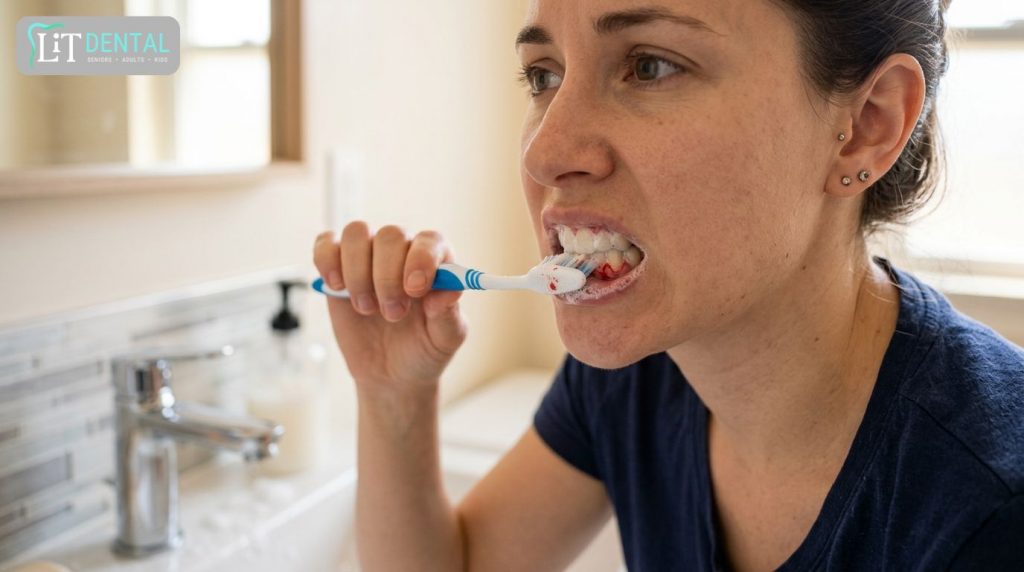
It is frightening when this happens as you brush your teeth with your toothbrush, or when you look at the sink and find blood in it after brushing your teeth. Whether bleeding gums are normal or a grave problem that a professional must be informed about is also a question that lingers in the minds of many people. Understanding the reasons behind the gums bleeding will enable you to tell the difference between bleeding caused by minor irritation and bleeding that is a sign of the gum disease that is in its early stages and requires treatment. Light bleeding one or twice may not be a basis to panic, but constant and frequent bleeding at the brushes may never be ignored.
LiT Dental in McKinney, TX is an establishment where we promote awareness to patients of the causes and reasons of their bleeding gums and provide them with holistic care that will not only heal their gums but also prevent serious dental complications such as gingivitis or periodontal diseases.
Why do my gums also bleed after I brush my teeth, even though I brush my teeth regularly?
Gingivitis, the primary cause of bleeding gums, is the first stage of gum disease because of the deposition of plaque along the gum line. Even the regular brushers may develop gingivitis unless the brushing is of sufficient quality to remove the plaque on the border of the teeth and gums. Should I be concerned about bleeding gums? Yes, because constant bleeding is a manifestation of inflammation, which should be treated. Your gums bleed immediately after you brush your teeth, then you have gums that are fighting off the bacteria in the plaque, creating an inflammatory response that can easily cause the tissue to bleed when irritated.
Gum Inflammation Symptoms.
Gum redness, gum swelling: Healthy gums are hard and pink, and inflamed gums are red, swollen, and painful – the disease symptoms of gum inflammation that lead to bleeding of inflamed gum tissues when brushed.
Bleeding during normal brushing: It is normal to have some blood during brushing of your teeth especially at the gum line which is an indication of your gums developing gingivitis even though you might not experience pain or other symptoms that are more apparent.
Is it gum disease or is there something deeper?
Bleeding gums is the first sign of gum disease, which is often an early symptom of gingivitis, which is reversible with the help of proper oral care and professional cleaning. However, the persistent bleeding can be one of the indications of more serious periodontitis that has not been treated, in case the infection has spread below the gum line, causing bone loss and even tooth loss. Attaining this information about factors that are leading to gums bleeding will make you be aware of when you should be assessed by a professional rather than perceiving bleeding as a normal and minor condition.
When to Be Concerned
- Several weeks of bleeding: Is there something wrong with my bleeding gums even when I managed to take control of my oral health? Yes, a hemorrhage that fails to heal within 7-10 days of better brushing and flossing is a known gum disease that requires professional intervention.
- Companion symptoms: Bad breath and bleeding, loose teeth, pus between teeth, or receding of the gums are indicators of advanced gum disease that requires immediate care by a professional to prevent long-lasting, irreversible effects.
Can one brush their gums and cause them to bleed?
Yes, that is one of the reasons of gums bleeding that most people do not attach much attention. Cleaning or brushing with a hard-bristled toothbrush or scrubbing hard tissue causes the gum tissue to be tender and causes bleeding, recession, and sensitivity. Pain in brushing of sensitive gums is also a common problem among people who have a well-intentional but hard-brushing habit due to the belief that brushing harder removes dirt and stains better, whereas in reality, they end up damaging gums and enamel. The brushes also perform wonders when they are correctly applied, as they are softly brushed in circular motion using soft-bristled brushes, which are able to clean the tissues without being traumatizing.
The effects of Brushing With Aggressive Fluoride.
- Gum tissue trauma: When the gum tissue is overly physically brushed so much, it will start bleeding and experience long-term gum recession that exposes sensitive tooth roots where they are not meant to be exposed.
- Sensitivity of the gums: Strenuous cleaning of the teeth leaves behind poor gums and frazilated enamel that causes sensitive gums cleaning issues, where ordinary oral care turns into painful and corrective oral care measures that promote additional problems instead of curing them.
Why do the gums bleed not when you brush them?
In addition to the causes that come with brushing, there are causes of swollen gums bleeding. The most significant one is the presence of plaque on the teeth – the viscous layer of bacteria that forms constantly and should be cleaned off daily with the help of proper brushing and flossing. Inability to completely eliminate the plaque also causes the inflammation of the gums under the influence of irritation by bacteria and bleeding. Other reasons which can cause bleeding gums are hormonal changes in pregnancy or menstrual, certain medications which make blood thin, deficiencies of vitamins (Vitamin C in particular), cigarette smoking and other general conditions such as diabetes.
Calculus and Oral Cleanliness Lack.
Weakly eliminating the deposits: bacteria in the body of the teeth surrounding the gum line causes gum inflammation, which is the first sign of gum disease, including redness, swelling, and bleeding.
Leaving out flossing: Brushing teeth alone is inadequate to wipe the teeth between gums where they are most likely to bleed, it is required to floss them on a daily basis to clear up these prone areas and preventing the onset of gingivitis.

Conclusion
Bleeding gums always need to be noticed and never be assumed to be normal. We have a full evaluation and treatment of gum disease with our highly qualified team of professionals at LiT Dental in McKinney, TX that covers all the causes of bleeding gums starting with the deposits of the plaque in the teeth and ending with severe periodontal disease in LiT Dental. We also offer complete dental care of dental crowns, dental veneers, dental bonding, and dental fillings in addition to gum care.

