
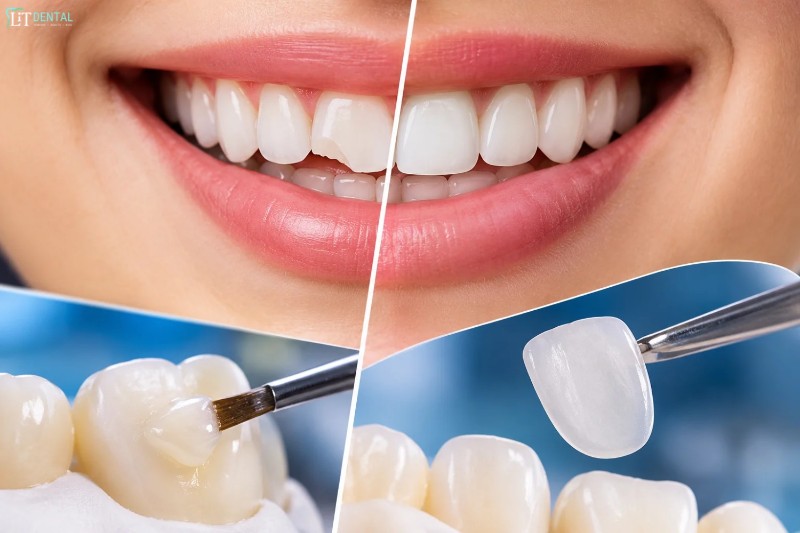
While gaps and chipped teeth can ruin the appearance of your smile, there are a number of cosmetic procedures that can improve it. Two of the most commonly used methods include porcelain veneers and dental bonding for tooth enhancement, camouflage of minor defects, and smoothing out the teeth. Both of these techniques offer results that appear natural, although the preparation used for each is different, along with the duration of the treatment, cost, and efficiency of each in treating diverse dental problems. Thus, gathering this information enables one to communicate the options available with his/her dentist so that the best procedure is chosen by the patient for the smile.
What are the distinctions of dental bonding from dental veneers when closing gaps and treating chipped teeth?
Dental bonding involves the application and shaping of tooth-colored composite resin by a dentist through the use of a special light. This form of dental treatment is widely used in cases of various minor problems like small chips and gaps as well as uneven edges. Dental veneers are very thin pieces of porcelain that are molded to fit over the tooth to improve its shape and color.
Dental bonding takes less time to prepare the tooth and is superior to porcelain veneers in terms of price, but veneers can last longer as a bonding method, provided that regular maintenance is performed on it. The time varies on the size of the chip or the gap as well as the state of the teeth and the cosmetic goals of the dentist.
| Dental bonding | Veneers |
| Usually requires little or no enamel removal. | Often requires some enamel removal, particularly for porcelain veneers. |
| Typically completed in one appointment. | Often requires two or more appointments, although some practices offer same-day workflows |
| Resin is applied, shaped, and hardened directly on the tooth. | Custom-made shells are bonded to the prepared teeth. |
| Often requires less time per tooth. | Requires additional time for impressions or scans, fabrication, and placement. |
| Often reversible when little or no natural tooth structure has been altered, although removal may still affect the tooth surface | Porcelain veneers are generally irreversible because enamel removal is usually necessary. |
What is the purpose of dental bonding in the repair of small tooth chips and gaps between teeth?
Dental Bonding involves attaching composite resin to the areas that require reshaping, thus restoring a natural shape for the tooth. Usually, this means:
- Tooth preparation: The dentist lightly prepares the surface of the tooth to ensure proper adhesion of resin.
- Color matching: Selection of a shade to match with adjacent teeth.
- Resin application: The dentist applies and forms resin to either seal a chip or minimize a small gap.
- Hardening and polishing: The resin is hardened with a special light and then smoothed and polished by the dentist.
The tooth surface may be lightly prepared, but bonding typically requires little or no enamel removal and is often completed in one appointment. Dental bonding before and after may show the possible changes that can occur, but they will depend on the individual patient.
How can porcelain veneers improve chips, uneven teeth, and gaps?
- Porcelain veneers are molded as shells and fit over the front teeth, improving their appearance. The procedure generally includes:
- Assessment of the teeth: The doctor checks the condition of the teeth and their alignment, as well as their suitability for veneers.
- Preparation of the tooth: The enamel is slightly removed if necessary, in order to make room for the veneers.
- Taking measurements for making molds or scans so that each veneer fits the tooth
- Installation: When the veneers are ready, they will be fitted into the teeth by the dentist.
Veneers can improve the appearance of chipped teeth, discoloration, gaps between teeth, and uneven edges. However, even though porcelain is easier to avoid staining, veneers require more funds and sometimes may lead to loss of enamel since installation involves reshaping teeth to form them. However, these shells are not suitable for all patients.
What is the best option if the chips are small or there is a larger gap or more noticeable gap?
If the chips are small or there is a larger gap or more visible defect, dental bonding may be more effective as it preserves more of the natural tooth. It can be repaired or adjusted if the resin is damaged. Porcelain veneers may provide more control of tooth shape/color and symmetry when greater cosmetic changes are warranted.
Veneers, however, do not necessarily represent the optimum solution for every obvious gap, however. For larger spaces, other factors such as alignment, bite, or missing teeth are more involved and need a different type of approach. Before recommending treatment, the cause should be examined by a dentist. The treatment for chipped teeth will vary depending on the severity of the damage and the overall condition of the tooth.
What looks more natural?
It really comes down to the individual tooth, as both dental bonding and veneers are equally capable of giving you natural results. Bonding utilizes composite resin that is the color of teeth. Your dentist is able to mold this resin right on top of existing teeth. It’s perfect for little chips, small gaps, and other slight defects. On the other hand, veneers come as shells and they’re made based on how you’d like your teeth to look. They can give a natural result to several teeth at once. Of course, all dental restorations depend heavily on the specific situation and how skilled your dentist is.
What is the difference in cost and affordability of dental bonding compared to veneers?
Generally, porcelain veneers are pricier than dental bonding, but this varies depending on how many teeth are getting repaired, how complicated the cosmetic repair for chipped teeth is, what materials are being utilized, and what the practice charges. Composite resin requires more frequent maintenance since it can chip and stain over time. Thus, while veneers may be more expensive to buy initially, they could last longer provided proper maintenance.
While both are cosmetic dental procedures, insurance would probably not cover most of their cost. Therefore, get a custom estimate and inquire about payment options first. LiT Dental offers bonding and veneers in McKinney, Texas, along with financing and payment information.
Expected lifespan of dental bonding vs veneers
The answer is both simple and complicated. Dental bonding often lasts around 3–10 years, while porcelain veneers may last 10–15 years or longer. Actual lifespan varies, and either restoration may need repair or replacement sooner. As you might expect, there is considerable overlap in these time periods because of variations in each person’s habits. For instance, poor hygiene will greatly reduce the lifespan of both. Other factors are hard to account for, like chewing ice and biting nails or using your teeth as tools to open a package. Both procedures will definitely be compromised by these habits. Even bruxism, more commonly known as tooth grinding, can quickly undo all your hard work by damaging either the bonding or the veneer. For that reason, a night guard is strongly recommended, especially for bonding.
Both treatments can last for many years if you are diligent. Bonding may require more frequent polishing or repairs because composite resin can chip and stain more readily. Veneers are generally more stain-resistant and longer-lasting, but they can also chip, loosen, or require repair or replacement.

Conclusion
Both dental bonding and porcelain veneers can help to enhance chipped teeth and fill in certain spaces, but they are not the same. Small imperfections are typically easier to bond than large ones, are often less expensive, less time-consuming, and less intrusive. Veneers can be considered by individuals who want to get more cosmetic change and increased stain resistance but come at a higher price and can require enamel removal. Both of these choices aren’t perfect for all people. A dental examination at LiT Dental can also help you determine the best and safest option based on your teeth’s condition, cosmetic preferences, and budget.
