
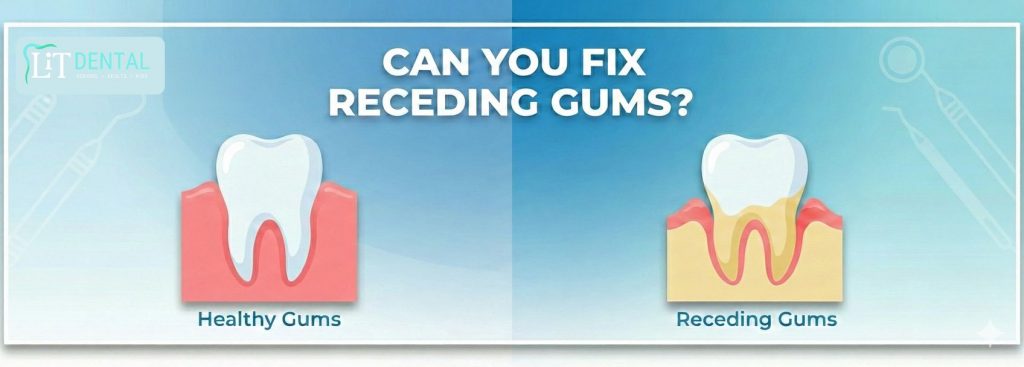
Have you noticed that your teeth have become longer than they were before? Are your gums appearing to recede away? Sunken gums are an issue that plagues numerous individuals and leaves one feeling embarrassed about the smile. You may be questioning yourself about why your gums are receding and whether the damage can be undone. The point is that there are a number of methods dental specialists may use to treat gum recession and care for your teeth. It is better to know how to correct receding gums and what causes it so that you can do something before things become worse.
Is there any way you can repair receding gums, or is it possible to treat?
Yes, the receding gums are treatable, but the method would be based on the severity of the condition. Recession of the gums is one of the issues that can be enhanced at the initial phases through better care of the mouth and professional cleaning of the mouth, which eliminates bacteria that lead to inflammation. More severe cases may need surgeries that envelop roots of the teeth and gum tissue. To know what to do to correct receding gums, it is important to begin with a professional examination by a dentist who will diagnose the damage and prescribe the necessary treatment. LiT Dental Family Practice provides extensive gum treatment, such as deep cleaning of the gum, gum grafting, and maintenance services, to ensure that the gum does not recede any further. Professional dentists are allowed to prescribe the kind of treatment that will suit your case best.
Nominal Professional Gum Treatment.
- Deep cleaning (scaling and root planing) to eliminate bacteria underneath the gumline.
- Gum grafting using the roof-of-the-mouth tissue.
- Pinhole surgical procedure of minimally invasive gum restoration.
- Guided tissue regeneration is used to assist the gums in growing normally.
- Professional cleaning of the premises after every 3-4 months.
- Suspension control- antimicrobial therapy.
- Individual nightguards to avoid grinding injuries.
Why do gums recede, and what are their impacts on oral health?
When you are wondering why your gums are receding, the reasons could be a number of factors. Bacteria-filled plaque is the top cause- makes the gum inflamed, which destroys tissue and bone supporting your teeth. Excessive brushing by using hard-bristled brushes may even cause gum tissue to wear out physically. There is also the influence of genetics some individuals have been genetically blessed with thinner gums more likely to recede. Receding gums expose the roots of the teeth, making them sensitive to cold and hot. Roots that are exposed are also at greater risk of decay because they lack protective enamel. The fact that the gums are receding may subsequently result in loss of teeth in case the supporting bone is fractured due to undetected gum disease.
Key Risk Factors of Gum Recession.
- Periodontal disease and persistent sausage inflammation.
- Vicious brushing of teeth using tough brushes.
- Heredity of thin or weak gums.
- Tobacco smoking destroys gum tissue and retards healing.
- Grinding or biting of teeth that results in gums that are over-strained.
- Bite malformed or crooked teeth that create uneven pressure.
- Lack of oral hygiene enables the accumulation of plaque and tartar.
- Pregnancy or menopause hormonal changes.
What is the method of diagnosis and treatment of early gum recession as done by dentists in LiT Dental Family Practice?
At LiT Dental, receding gums are diagnosed by licensed dentists using a complex oral examination involving the determination of gum attachment levels around a tooth. They seek the presence of gum disease, such as inflammation, bleeding, and bone loss, as evidenced in X-rays. Being aware of the cause of your gums’ receding will enable me to treat the gums specifically in your case. In the case of an early recession, the process of treatment is usually done to combat recession by increasing oral hygiene and professional cleanings to prevent the progression. Dentists also educate about problem-free brushes and mild circular movements to teach the proper brushing technique. They can suggest certain toothpastes or antimicrobial rinses as far as sensitivity is concerned. The constant check-up is important to check that the receding gums are not getting worse and in case more treatment is needed, it can be intervened early.
What are the surgical and non-surgical treatments that assist to restore gum tissue?
To know how to correct receding gums one has to know both non-surgical and surgical methods. The mild recession is best treated using non-surgical options, which involve deep cleanings that clear bacteria and toxins out of the tooth roots, and the gums reattach naturally. Results can be maintained by better home care and proper technique of brushing and daily flossing. In case of moderate to severe gum recession, surgeries are required. Gum graft surgery involves the use of tissue on the top of your mouth and using it to cover roots that have receded. The pinhole method involves the use of a pinhole to be able to reposition the gum tissue already present without grafting. LiT Dental will be able to assess the level of gum disease and prescribe the necessary treatment.

Conclusion
Why are my gums receding can be used to solve the issue at the base, whether it is gum disease, brushing method, or any other. The LiT Dental located in McKinney, TX is a center that gives all-around gum care to patients with recession. When patients see our qualified dental staff, they have their gum health tested regularly, and the issues are diagnosed at an early stage when treatment is less complex and invasive. Professional cleanings, deep scale operations, and surgical procedures to restore gum tissue are our offer.

